Rousing the Sheep
A brief history of strikes in Aotearoa, from early resistance to the blood-soaked Great Strike of 1913: Part One

Unbeknown to most New Zealanders, Aotearoa’s history is littered with grand acts of resistance. From raging street battles between revolutionary socialists and special constables, to the General Strike that nearly brought down the Muldoon government, passivity wasn’t always a common trait in the land of the long white cloud. Here’s part one of the story many have forgotten, but all ought to remember.
Waitangi to the 40-hour work week
The first recorded ‘strike’ in New Zealand’s history occurred shortly before the signing of Te Tiriti o Waitangi, when Māori timber workers demanded to be paid in cash or gunpowder, in lieu of food, and walked off the job until their demands were met. Māori were on strike again in 1848 when several hundred Auckland-based Māori roadworkers protested after they learned that Pākehā labourers had been offered higher wages. George Grey, then Governor, threatened to sack them. He’d do worse to Māori in due course. The 1840s were also marked by carpenter Samuel Parnell’s demand for a 40-hour work week, a feat commemorated each Labour Day. While Parnell was fortunate, since his skill was in short supply, other workers had to wait until the 1940s to gain the right to such ‘generous’ terms.
1890 Maritime Strike
From the 1860s, workers, especially sailors, shearers and miners, began to unionise, but it wasn’t until 1889 that the first nation-wide labour organisation was formed. With between 20,000 and 60,000 members, the Maritime Council, comprised of sailors, watersiders and miners’ unions, was a formidable force. In 1890, they struck to support their Australian counterparts. This first bout of industrial action failed, but not before it brought New Zealand’s wharves to a halt.
Women at work
While the Maritime Council was doing battle with the state, New Zealand’s first women’s labour body was formed. The 1889 Dunedin Tailoresses’ Union represented up to 1,400 women and achieved reduced hours, higher pay, and the appointment of female factory inspectors. This group also played a critical role in the early suffragette movement.
The Liberal Government elected during the maritime strike attempted to soothe class tensions by passing the Industrial Conciliation and Arbitration Act. This allowed workers to register craft unions and forced employers to the negotiating table. While the Act empowered the Arbitration Court to make awards that bound all employers and workers in an industry, it barred unions from organising strikes as a bargaining tool. Despite the 1890 failure, by 1901 there were 175 unions representing over 18,000 members. Though the model worked for more conservative unions representing skilled workers, it angered the radicals representing the lower-skilled, whose contributions were less likely to be recognised by the Court. Some of these ‘fringe’ figures would later rise to prominence through the Labour Party.
Land without strikes, yeah right
By the dawn of the twentieth century, Aotearoa was one of the most heavily unionised nations on the planet. Membership increased rapidly over the 1900s, and soon 100,000 (20% of the male working population) were unionised. Female trades, meanwhile, had poorer representation, at around 2%. The Liberal Government became increasingly illiberal, especially after the death of Premier Ballance. By the time Joseph Ward took charge, the Liberal Party was on the precipice of the downward spiral that would later see it forced to merge with Reform to create the New Zealand National Party. The decisions of the Arbitration Court began to increasingly reflect the needs of capital, not labour, and in 1906 Auckland tramway workers staged an illegal strike to protest the firing of two co-workers. This marked the first round of mass action since the arbitration model came into force. Next were the freezing workers in 1907. Workers learned they could gain more fighting against the system than within it.
Let the man eat his pie! The Blackball Strike 1908
In the small West Coast town of Blackball, miners were only allowed a 15-minute break for lunch. Breaking with the arbitration system, miner and union leader Pat Hickey (later president of the Melbourne Labor Party) refused to finish his pie on time. Hickey and his supporters were fired, but the rest of the Blackball Miners’ Union went on strike. For refusing to bow to the Arbitration Court, the miners were fined, and when the men refused to pay, their possessions were seized and put up for auction. Most locals refused to bid or returned the goods to their owners, meaning the Court gathered pennies, not pounds. After months, the company gave in, and the fired miners got their jobs back, along with a proper lunch.
Emboldened by the victory at Blackball, various miners’ unions joined to form the Federation of Labour, the nation’s second attempt at a nation-wide workers’ organisation. Later known as the Red Feds for their radicalism, the group was led by Bob Semple, later a Labour MP, with pie-proletarian Pat Hickey as secretary.
1912 Waihi Miners’ Strike and Fred Evans
Turn-of-the-century mining was a dangerous gig, and even gold miners made a pittance. Men went into the mines at 16 and were lucky to make it to 40. Black lung and other ailments proved more dangerous than accidents, and in 1912, tensions were high across Waihi. When a group of skilled workers who wanted to take a more moderate stance than the Red Feds formed their own company-backed union, conflict erupted.
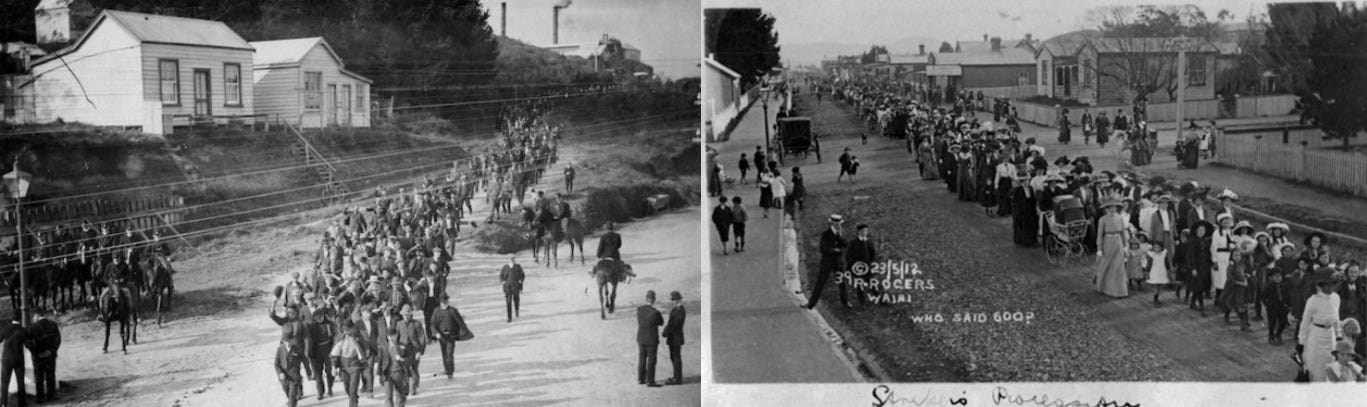
The six-month strike saw nearly ten percent of New Zealand’s police force engaged. The Dickensian Waihi Goldmining Company attempted to use scab (non-union) labour to break the strike, leading to bloodshed. On ‘Black Tuesday’, a group of these local traitors, joined by police, attempted to storm the Trades Hall and evict the union members. Both groups were armed. A scab and a constable were shot, while Fred Evans was beaten to death. No one was ever charged, a theme that you’ll see repeated in cases of anti-worker political violence.
Class warfare on the horizon
The Red Feds weren’t ready to give up the fight. In the shadow of the aborted Russian Revolution of 1905, class warfare was on the rise, and it was coming for Aotearoa. In 1913, the streets of Wellington would run red.
There was a lot of action too in 1951 when the Waterside workers struck in Auckland and there were by some accounts riots.
Ken Douglas was head of the CTU when the 4th Labour Government passed law eroding much of what had been achieved by all the decades of Union activity. Because of his complicity his name has gone down in infamy.